
Once a specialist search gets approved, time becomes the biggest variable for hospital leaders seeking quality infectious diseases care.
Physician searches now average nearly four months to reach signing, and specialty and surgical searches routinely stretch to a year or more, according to AAPPR’s 2025 recruitment benchmarking report.

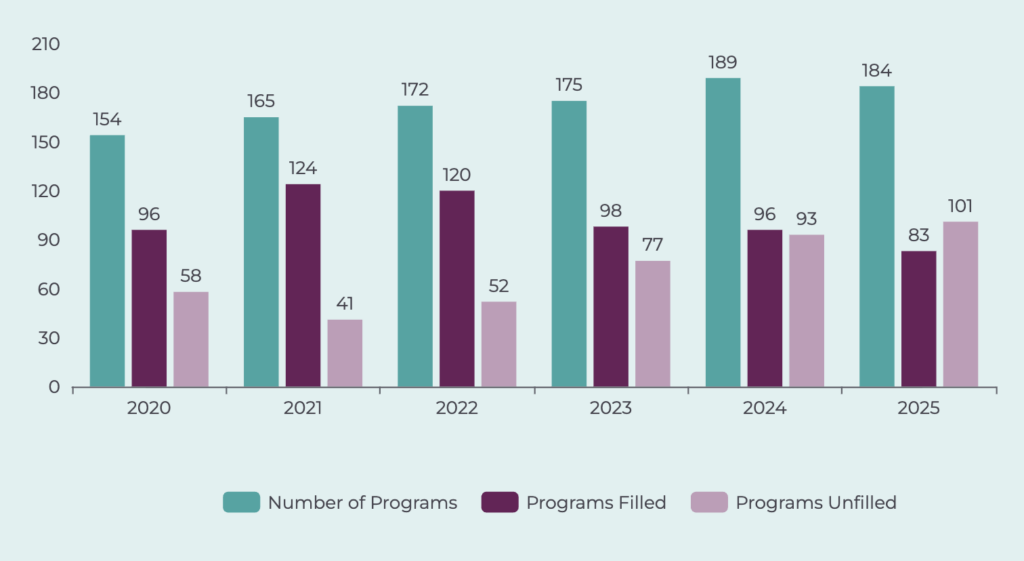
For infectious diseases, the odds are worse. NRMP data shows the adult ID fellowship match fill rate fell to 60.9% in 2025 — a 9.3-point drop from the year before — with unfilled programs climbing. A shrinking pipeline of trainees means fewer new ID physicians entering the field as demand keeps rising.
ID Fellowship Match Fill Rate and Program Trends (2020-2025)
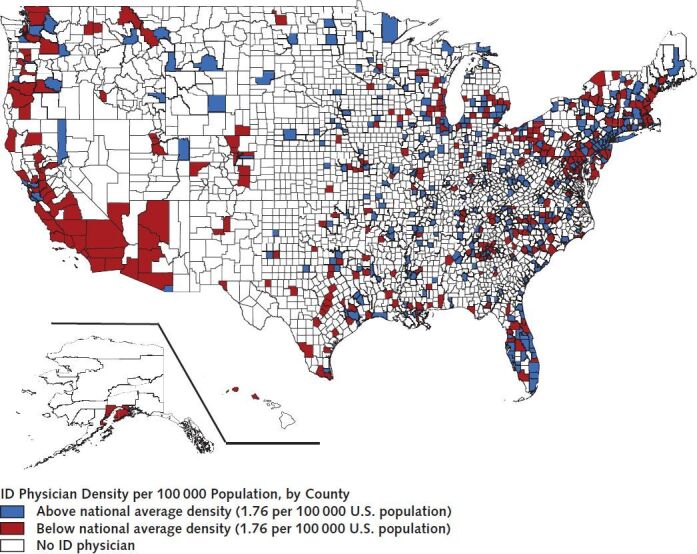
Source: Walensky RP et al., Ann Intern Med 2020
Roughly 80% of U.S. counties have zero ID physicians, leaving more than 200 million Americans with minimal to no access to ID expertise.
If your hospital sits in one of those counties, you’re not only competing for a scarce specialist, you’re asking someone to relocate to a market with, by definition, no existing ID presence to recruit from.
This is part of a much larger physician workforce problem. HRSA projects a total U.S. physician shortage climbing toward 187,000 by 2037, and AAMC’s own modeling points to a shortfall of up to 86,000 physicians by 2036. Both projections agree the pain lands hardest outside major metro areas.
A Costly Wait for Your Hospital
Specialist recruiter fees alone can run $25,000–$50,000 per hire, with total direct investment, including sourcing, interviews, sign-on bonus, and relocation potentially reaching $150,000–$250,000 before a single day of lost revenue is counted.
Beyond the direct spend on recruiting, relocation, and sign-on bonuses, an open ID position drains the hospital’s bottom line each day you go without coverage in less visible ways:

- Delayed or suboptimal antibiotic management allows infections to worsen
- Hospital stays run longer and more expensive
- Transfers that could have been avoided become unavoidable
- Readmissions and complications climb
- Antimicrobial stewardship opportunities are lost
- Risk for hospital-acquired infections increases
Weeks, Not Months
ID telemedicine removes the geography constraint. Tele-ID physicians can practice from anywhere, so a hospital isn’t limited to specialists willing to relocate — it can draw from a supply of academic-affiliated, board-certified ID physicians licensed in your state. At Infectious Disease Connect, each hospital is assigned a dedicated “pod” of physicians who function as an extension of your onsite team.
That’s a pipeline advantage, not a hiring gamble.
That’s a pipeline advantage, not a hiring gamble, and the outcomes data backs it up. In a peer-reviewed study conducted by our physicians at one of our partner hospitals, switching from periodic in-person ID coverage to daily tele-ID:

Cut average length of stay by 17% (9.08 → 7.5 days, p=.003) — even though the tele-ID group had significantly higher-acuity patients (Charlson Comorbidity Index 5.3 vs. 4.5, p=.047)

Cut IV antibiotic discharges by a third (51% → 34%, p=.007) — reducing the infusion-related costs, supply-chain dependencies, and home-nursing burden that come with IV therapy at discharge

Drove a statistically significant IV-to-oral antibiotic shift — oral antibiotic discharges rose from 23% to 39% (p=.014), a nearly 70% increase in the group discharged on oral therapy

Held in-hospital mortality (2% vs. 2%) and tertiary-transfer rates (13% vs. 14%) steady — with no statistically significant difference, despite tele-ID treating a meaningfully sicker patient population.
The Practical Result

A virtual program can be live within weeks, making a near-immediate impact on your hospital’s bottom line, your quality goals, and your patient satisfaction.
If you’re struggling to find the right fit for your hospital, you can get started with Infectious Disease Connect’s tele-ID coverage in as little as a few weeks.
You might also like…
Infectious Disease Connect Brings Tele-ID Research and Education to IDWeek 2026

Andrea Carlo Anglero, M.D., Presents at AMPRO 2026 Convention

Putting a Number on the Curbside: ID Connect-Led Study Gets IDSA Spotlight